What Is Artificial Intelligence? A Complete Beginner's Guide
You have heard the term everywhere — in news headlines, product advertisements, school discussions, and workplace conversations. Artificial intelligence, or AI, is being called the most transformative technology of the 21st century. But what exactly is it? If you have ever felt confused by terms like machine learning, neural networks, large language models, or generative AI, you are not alone. In this beginner's guide, we break down everything you need to know about artificial intelligence in plain, simple language — no technical background required
The Simple Definition of Artificial Intelligence
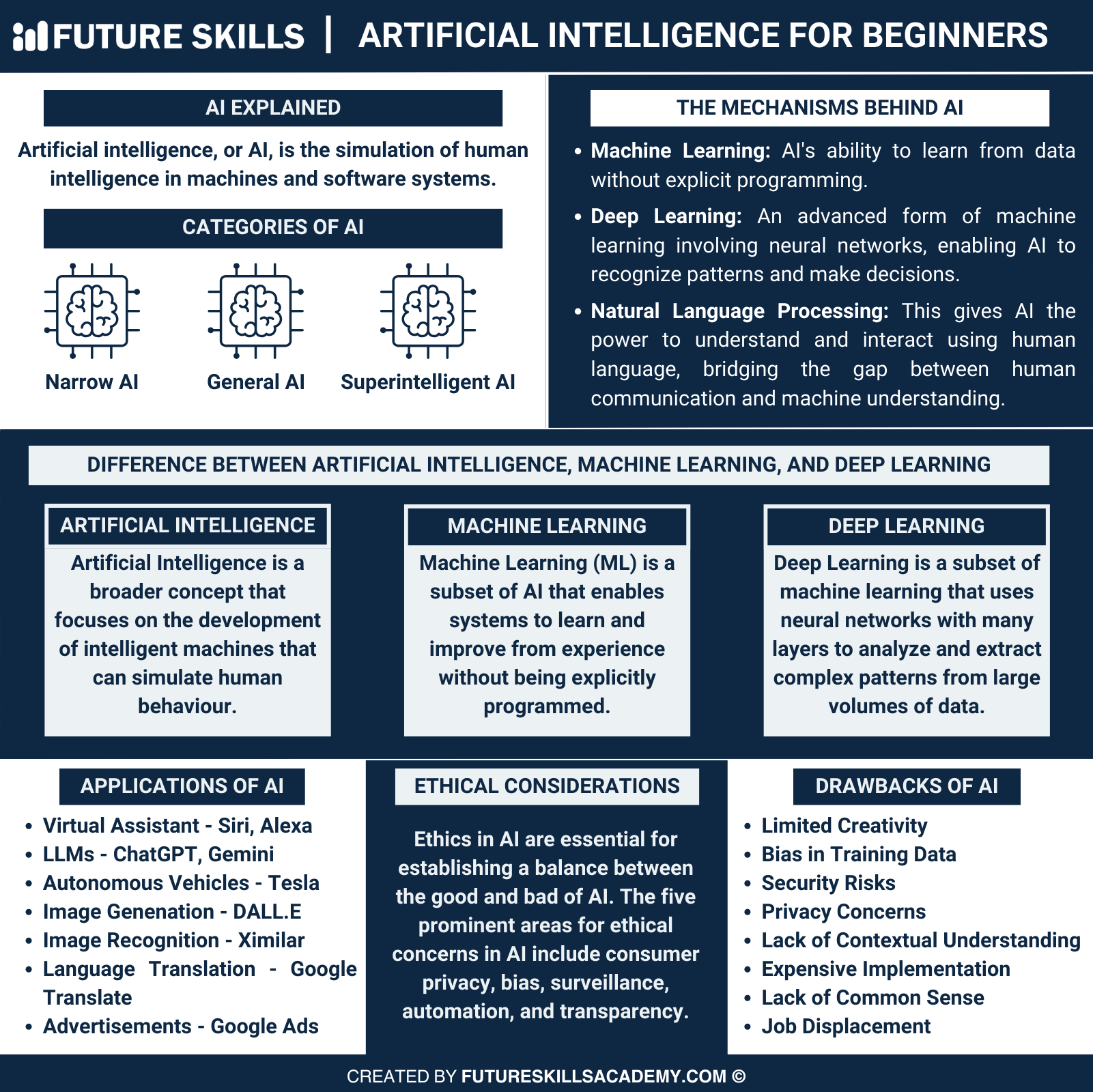
At its core, artificial intelligence refers to computer systems that can perform tasks that normally require human intelligence. These tasks include understanding language, recognizing images, making decisions, solving problems, and learning from experience. Think of AI as a very advanced form of pattern recognition. When you feed a computer enormous amounts of data and teach it to identify patterns within that data, it can start making predictions, generating content, or taking actions — sometimes with stunning accuracy.
A Brief History of AI
The concept of artificial intelligence is not new. The term was coined by computer scientist John McCarthy in 1956 at a conference at Dartmouth College. Early AI systems were rule-based — programmers manually coded rules for the computer to follow. In the 1980s and 1990s, progress was slow. But the explosion of internet data in the 2000s, combined with more powerful computers and breakthroughs in machine learning, changed everything. The launch of ChatGPT in November 2022 marked the beginning of the current AI era — one defined by accessible, conversational AI tools that anyone can use
Types of Artificial Intelligence
Narrow AI (Weak AI): This is the type of AI that exists today. It is designed to perform specific tasks very well — like recognizing faces in photos, recommending Netflix shows, or translating languages. All current AI tools, including ChatGPT and Gemini, are forms of Narrow AI. General AI (Strong AI): This hypothetical form of AI could perform any intellectual task that a human can. It does not exist yet. Superintelligence: A theoretical AI that surpasses human intelligence in every domain. This is the type of AI discussed in science fiction films
What Is Machine Learning?
Machine learning is a subset of AI that focuses on training computers to learn from data rather than programming them with explicit rules. Instead of telling a computer 'if an email contains the word free money, mark it as spam,' machine learning allows the computer to analyze thousands of spam and non-spam emails and learn the patterns itself. This approach has proven far more effective than rule-based programming for complex tasks like speech recognition, image analysis, and language understanding
What Is Generative AI?
Generative AI is the type of AI most people interact with today. Unlike AI that only analyzes or classifies existing information, generative AI can create new content — text, images, audio, video, and code — that did not previously exist. ChatGPT, Claude, Gemini, Midjourney, and DALL-E are all examples of generative AI. These tools are powered by large language models (LLMs) that have been trained on vast amounts of human-generated text and data from the internet.
Real-World Applications of AI
AI is already deeply embedded in your daily life: Healthcare: AI helps doctors detect cancer in medical scans and accelerate drug discovery. Finance: Banks use AI to detect fraudulent transactions in real time. Transportation: Self-driving car technology relies on AI to navigate roads and make split-second decisions. Education: AI tutors personalize learning for students. Entertainment: Every recommendation on Netflix, Spotify, or YouTube is powered by AI algorithms that learn your preferences.
Is AI Dangerous?
This is one of the most debated questions in technology. AI brings genuine risks, including job displacement, misinformation, privacy violations, and the concentration of power in the hands of a few large technology companies. However, responsible development, regulation, and education can mitigate many of these risks. Organizations like Anthropic (the creator of Claude) are specifically focused on building AI that is safe, honest, and beneficial to humanity. The key is not to fear AI, but to understand it.
How to Start Learning About AI
The best way to understand AI is to use it. Start by experimenting with free tools: Sign up for ChatGPT at chat.openai.com and ask it questions about topics you care about. Try Claude at claude.ai for research and document analysis. Experiment with Midjourney or DALL-E to create AI-generated images. For deeper learning, platforms like Coursera, edX, and Khan Academy offer free AI and machine learning courses designed for beginners.


Comments
Post a Comment