Will AI Take Your Job? Here Is What the Research Actually Says
Fear of job loss to automation is not new — workers have worried about machines replacing them since the Industrial Revolution. But today's AI is different. Unlike earlier machines that replaced physical labor, modern AI can perform cognitive tasks: writing, analyzing, coding, designing, advising, and even creating art. So should you be worried? The honest answer is: it depends on your job, your industry, and how quickly you adapt. In this post, we examine what researchers, economists, and real workplace data tell us about AI and the future of employment.

What the Research Says
A landmark 2023 study by Goldman Sachs estimated that AI could potentially automate tasks equivalent to 300 million full-time jobs globally. However, the same report noted that historically, automation creates new jobs alongside eliminating old ones — often more than it destroys. A separate report by the McKinsey Global Institute found that while up to 30% of work hours across the global economy could be automated by 2030, the majority of workers will not see their entire jobs disappear. The consensus among economists is this: AI will transform jobs, not simply eliminate them.
Jobs Most at Risk from AI Automation
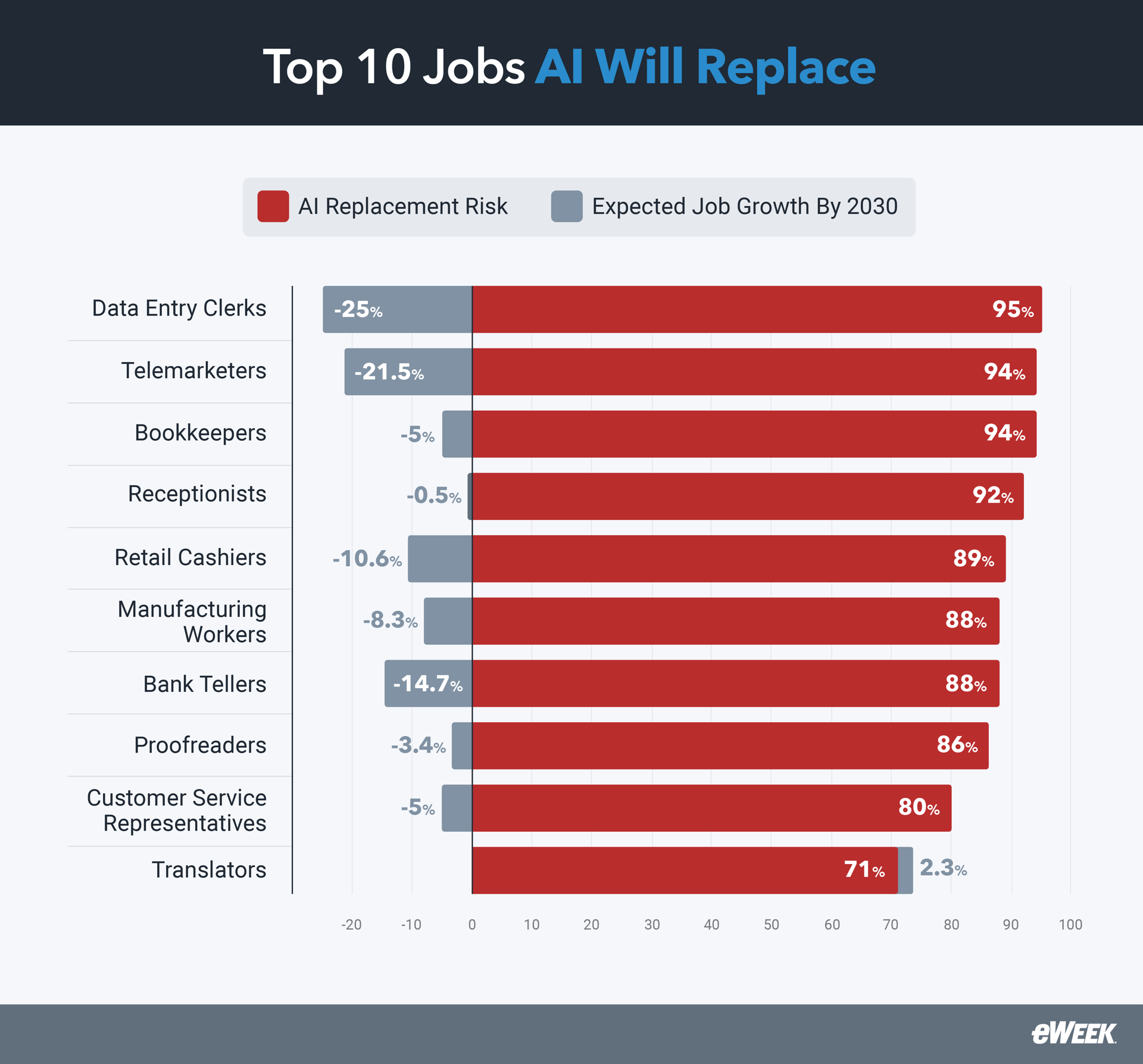
Data entry and processing: Repetitive data tasks are already being automated at scale. Customer service and call centers: AI chatbots are now handling millions of customer inquiries without human intervention. Transportation and logistics: Self-driving technology threatens long-haul truck driving and delivery driving over the next decade. Basic content writing: AI can produce generic blog posts and product descriptions at a fraction of the human cost. Accounting and bookkeeping: Routine financial record-keeping is increasingly handled by AI-powered software
Jobs Least at Risk from AI
Creative and strategic roles: While AI can assist with creative tasks, the highest-level creative direction, strategic thinking, and original idea generation remain human strengths. Care professions: Nursing, elder care, childcare, and social work require deep human empathy that AI cannot provide. Trades and hands-on work: Electricians, plumbers, carpenters, and other skilled tradespeople perform variable physical tasks in unpredictable environments. Leadership and management: Motivating teams and making complex organizational decisions require emotional intelligence that AI lacks. Research and innovation: Scientists and engineers push the boundaries of human knowledge in ways that require genuine curiosity and insight

The New Jobs AI Is Creating
For every job category AI threatens, new roles are emerging: AI Trainers and Prompt Engineers who teach AI systems how to behave. AI Ethics Officers who ensure AI systems are deployed responsibly. AI Integration Consultants who help organizations implement AI tools. Data Scientists and ML Engineers who build, train, and maintain AI systems. Content Creators Using AI who leverage tools to produce content faster and at higher quality
How to Future-Proof Your Career
The most resilient workers in an AI-driven economy will be those who treat AI as a collaborator rather than a competitor. Learn to use AI tools in your field — there are AI tools that can make you significantly more productive. Develop uniquely human skills: Empathy, creativity, complex communication, and leadership will always be in demand. Stay curious and keep learning: The half-life of skills is shrinking. Build adaptability: The workers who thrive through technological transitions are those who embrace change rather than resisting it
The Bottom Line
Will AI take your job? For most people working today, the answer is not a simple yes or no. AI will change your job — possibly significantly. Some tasks you currently perform will be automated. But new tasks and entirely new roles will emerge in their place. The greatest risk is not AI itself — it is failing to adapt. Those who learn to work alongside AI and continually develop their uniquely human skills will not just survive the AI revolution. They will thrive in it.


Comments
Post a Comment